The work takes place at the Mojave Bloom research compound in Las Vegas, with sensor stations in the yard, the garden beds and the trees. Results are compared with the official weather station at the airport (KLAS).
Ongoing since 2026
Backyard climates versus the airport
Small sensor stations log air, soil and light every 30 seconds in different parts of one yard.
Summer nights in the yard ran 5–8 °F cooler than the airport.
A courtyard in full shade stayed about 4 °F cooler than the airport during the day.
Sensors left in the sun read up to 47 °F above the airport, mostly from the sun heating the sensor itself. In this valley, a sensor needs a vented sun shield.
Valley research, 2026
Chill hours depend on where you live
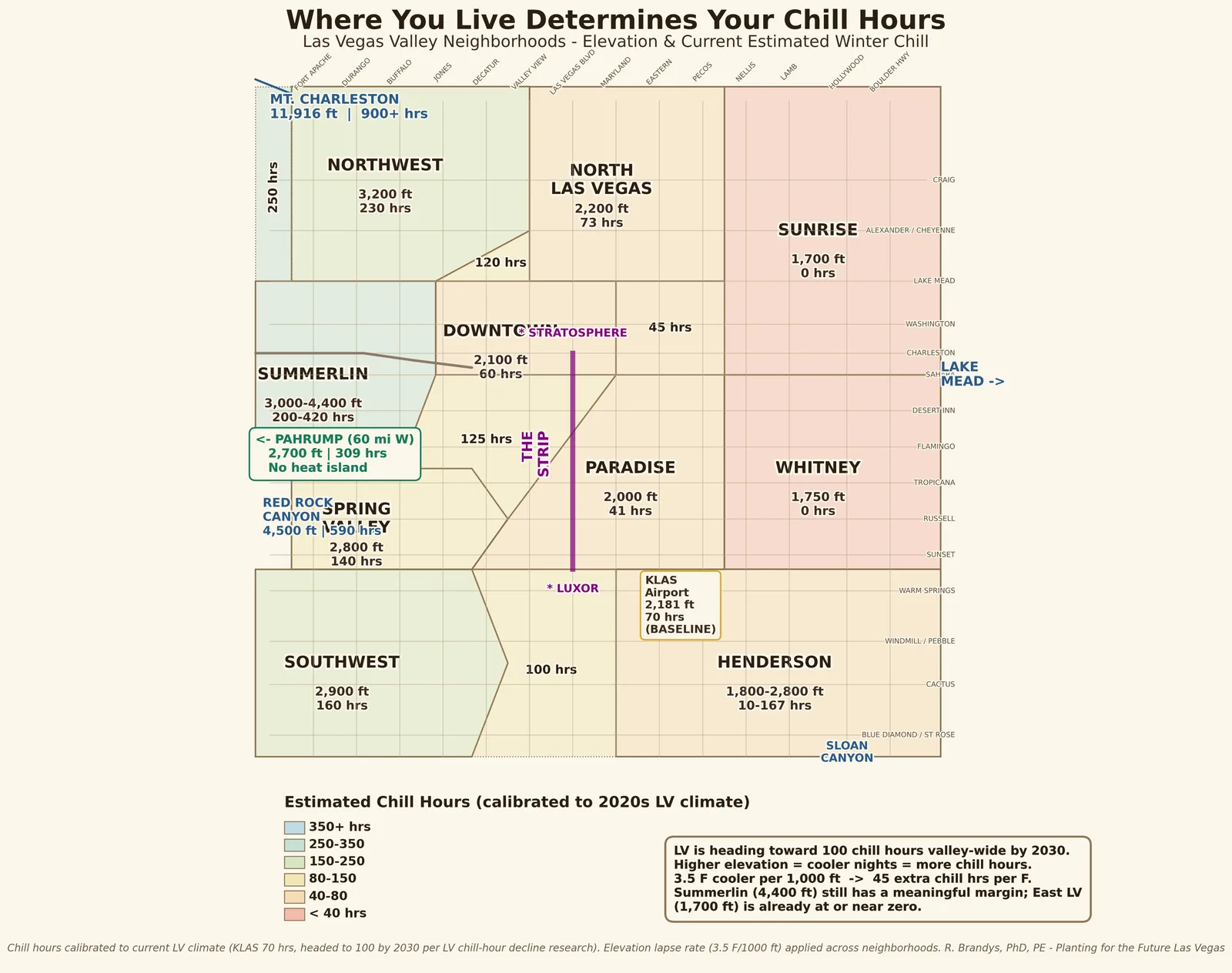
Do not use airport (KLAS) temperature data to estimate chill hours at your location.Counted straight from the airport record, the valley gets about 570 chill hours a winter. Reports from hundreds of Las Vegas gardeners and a research orchard show far fewer. Calibrated to what gardens actually experience, the airport area gets about 70.
Chill hours are winter hours below 45 °F. Many fruit trees need hundreds of them before they bloom well. Higher neighborhoods have cooler nights and more chill: about 3.5 °F cooler for every 1,000 feet of elevation. The east side of the valley is already at or near zero.
Estimated winter chill hours, calibrated to the 2020s Las Vegas climate. Bars show the typical value; lines show the range inside Summerlin and Henderson. Higher ground outside the valley gets more: Red Rock Canyon about 590 hours, Mt. Charleston 900 or more.
Map: elevation and estimated chill hours by neighborhood. R. Brandys, PhD, PE, Planting for the Future Las Vegas.Starts November 2026
Winter chill on real branches
Weather stations measure air in the shade. Buds sit in the sun. On a sunny winter day, a branch can run far warmer than the air, and warm hours cancel chill.
Probes on sunny and shady branches of two pluot trees, compared with shaded air and the airport.
A white reflective coating on some branches, to test whether keeping buds cool gives back lost chill.
A matching trial at a community experimental orchard.
Built into the water matrix
How much water does a desert plant need?
A plant is adapted to the rain where it evolved. The driest parts of the valley supply about 2.1 inches of rain a year that plants can use. The rest has to come from irrigation.
Minimum extra water (inches a year) = lowest yearly rain in the plant’s home range − 2.1. See the water matrix.
Valley research, 2026
Irrigation for the Las Vegas climate
Research on how irrigation water behaves in native and amended soils, and how fast it evaporates from the soil depending on temperature and air movement.
 BEST Academy